


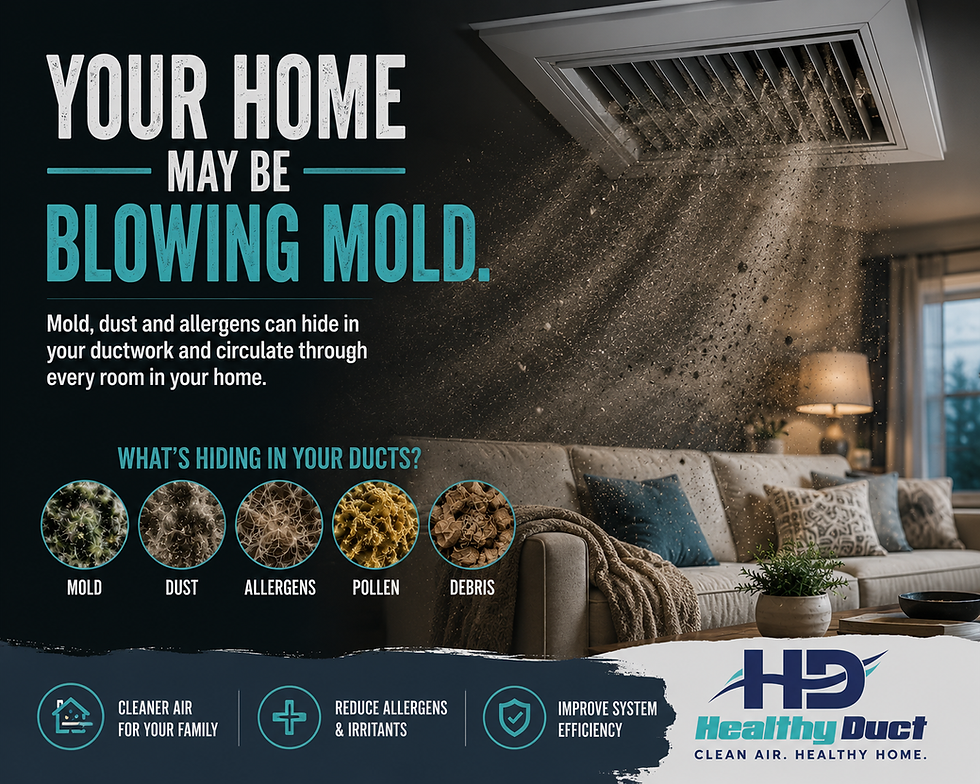
Your Home May Be Blowing Mold

When most homeowners think about mold, they picture visible black spots on a bathroom ceiling or water damage in a basement. What many people don’t realize is that mold can also exist inside the HVAC system quietly circulating through the air they breathe every day.
Your heating and cooling system is designed to move air throughout your entire home. If mold, excessive dust, or contaminated insulation are present inside the system, that same airflow can carry spores, allergens, and debris from room to room.
How Mold Ends Up in HVAC Systems
Mold needs three things to grow:
Moisture
Organic material (dust is enough)
Darkness and limited airflow
Unfortunately, HVAC systems can provide all three.
Common areas where microbial growth is found include:
Evaporator coils
Blower compartments
Drain pans
Return ductwork
Internally lined duct systems
Vent boots and ceiling cavities
Even small moisture issues or years of dust accumulation can create conditions where mold begins to develop.
Signs Your HVAC System May Have Mold
While not every dusty system contains mold, there are several warning signs homeowners should pay attention to:
A musty odor when the system runs
Dark staining around vents or registers
Allergy symptoms that worsen indoors
Excessive dust buildup around vents
Recent water damage or humidity problems
Condensation around HVAC equipment
Mold discovered elsewhere in the home
In many homes, homeowners are surprised to learn that the HVAC system itself may be contributing to ongoing indoor air quality concerns.
Why It Matters
Your HVAC system continuously recirculates air throughout your home. If contamination exists inside the system, it can repeatedly distribute:
Dust
Allergens
Fiberglass particles
Mold spores
Odors
For individuals with asthma, allergies, sensitivities, or compromised immune systems, poor indoor air quality can become especially problematic.
What Can Be Done
A proper HVAC inspection can help determine whether contamination exists within the system and whether cleaning or remediation is appropriate.
Depending on the findings, recommendations may include:
NADCA-standard air duct cleaning
HEPA-rated negative air cleaning
Mechanical brushing and agitation
Sporicide treatment
Fogging applications
Repairing duct leakage and boot connections
Encapsulation of damaged internal insulation
Installation of advanced air purification systems such as PCO technology
Just as importantly, any underlying moisture issue should be addressed to help prevent future microbial growth.
Clean Air Starts with the System Moving It
Many homeowners spend significant time cleaning surfaces throughout their homes while never considering the condition of the system moving the air itself.
If your home has persistent odors, unexplained dust, allergy concerns, or visible contamination around vents, it may be time to have your HVAC system professionally evaluated.
Because sometimes the problem isn’t just the air in your home.
It’s what your home may be blowing through it.


Comments